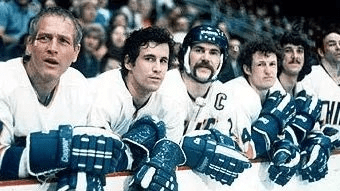
Do you ever have those moments when you hear a few funny quotes being circulated around town but you don’t realize they’re from a popular movie? I’ve had that happen. In fact, I just recently realized it had been happening to me for a solid 20+ years. Living in Minnesota, which is sometimes nicknamed “The State of Hockey,” I would often hear quotes such as “Called us names!,” “Get me a grape and an orange. And none of that stinkin’ root beer!,” or my baseball team’s commonly used quote (more than half of us were unaware of its origin) when chirping the other team if they made any errors: “Buy ya a soda after the game.” Well up until this week, I had no idea any of those quotes came from George Roy Hill’s 1977 film Slap Shot. I almost feel a bit ashamed that it has taken me this long to watch the film considering the fact that I’m a film lover as well as a Minnesotan. Because of Slap Shot’s unfiltered and creative use of foul language, many audiences cried out for the film to be censored. Although my research didn’t find much in terms of the film effectively being censored in any way, I found many reports and reviews that support the idea that many audiences and critics found the language as well as the almost glorification of sports violence to be quite off putting. The film has now become a beloved classic. In 1998, Maxim magazine named Slap Shot the greatest guy movie of all time. Idk if it’s a better guy movie than Predator, but it’s unquestionably, in my humble opinion, a better film overall. In 2007, GQ named it the best sports film of the past 50 years. Finally, it made Entertainment Weekly’s list of the top 50 cult movies of all time. The film is clearly held in high regard today, but audiences in 1977 were clearly not prepared for a film that brought them authentically (somewhat) into the world of amatuer hockey.
So I want to take a look at a few quotes and moments from the film and really unpack why audiences and critics of the time were so seemingly turned off by the film. There are a few various reasons why audiences at the time may have been averse to the film, but I’m going to initially start with the profane language that is consistently featured. In one of the hockey games that opens the film, an audience member yells at one of the players and calls him a “frog pussy.” I’m still not entirely sure what that means exactly, but the film early on set my expectations for a lot of creative cursing. This also immediately touches on a trend that is presented throughout the film: The use of the word “pussy.” It’s probably the most common dirty word used throughout the film. Though, the word itself actually holds a fair amount of significance in not only the film’s themes, but the plot as well. The word is once again used in a scene that involves the children of one of the team’s boosters. They are watching TV in the room adjacent to where Newman and this booster are having a meeting. Before the door is shut to the room with the children, we hear the two arguing over what to watch. The brother says “you stupid little…*door slams shut*” A few moments later, the young girl comes into the other room and says her brother called her “a pussy.” The dad blows it off, picks the girl up, puts her back into the other room and says to “work it out amongst themselves.” Great parenting, dad. This scene is played for laughs, but I know for a fact a scene like this wouldn’t fly today. Using the word “pussy” in any context is seemingly a big no-no for today’s sensibilities. Oddly though, I think this scene would’ve worked great for the target audiences of the time. This scene also begins to highlight the subtle thematic use of the word throughout the film. Although not a serious scene, the use of the word highlights the struggles that the various characters are going through. The film is set in a small, economically struggling mountain town and the various characters are down on their luck in a multitude of ways. The film presents these characters as people who need to pull themselves up by their bootstraps and make their own luck. The word “pussy” is commonly directed toward both males and females alike in order to inspire them to harshly look at themselves in the mirror and convince them to be proactive about taking the steps to improve their lives, regardless of how difficult and painful it may be. Although nowadays “pussy” is no doubt a touchy word considering audiences are recently becoming more aware of the sexist origins/undertones of the word. Though, that outlook on the word is not presented within Slap Shot. Audiences in 1977 probably just thought of it as a common and gender-neutral insult. This is proven through the pacifist character and his wife. Throughout the film, they are struggling with their relationship. The pacifist’s wife is upset because he has dragged her along to some one-horse town so he can play amatuer hockey. It is no coincidence that she throughout the film dresses in a classic tomboy style. She wears loose flannels and doesn’t seem to care much about her cosmetic status. When the championship game comes along, the team plays like losers in the first period. The GM comes into the locker room and chews them out for being “a bunch of pussies!” This fires up the entire team excluding the pacifist character. The pacifist character sits on the bench while both teams brawl. He looks up into the stands and sees his wife who had just gone to the salon and was given a beautiful makeover. The lady who gave her the makeover convinces the pacifist’s wife that being a single girl is empowering and gives you a whole new lease on life. She realizes that she is capable of controlling her own life. Once the pacifist sees his wife, he is reminded of how much he loves her. He proceeds to skate onto the ice and femininely striptease the audience in the midst of all the fighting. This allows him to win back his wife. They both accept femininity in their lives and it helps them to then repair their relationship. Hidden under the machismo of a film about amatuer hockey and its juvenile players is actually a touching ode to femininity. This somewhat contradicts the title of “greatest guy movie of all time.” Though, that type of message might be exactly what a lot of guys need.
Although there are a lot of other commonly used curse words throughout the film such as “fuck, shit, ass, dick, and cunt,” “pussy” seems to be the one of all these words that holds thematic significance. I feel that if audiences would have noticed this really subtle and impressive writing as opposed to the crude and satirical sports farce the film presents as its veil, the outcry for censorship wouldn’t have been nearly as strong. I also have a sneaking suspicion that audiences had probably already often been exposed to those other curse words I just mentioned. The censorship outcry makes the most sense if the problematic word was used consistently and often (as “pussy” is used throughout the film). I can’t imagine “fuck” would cause too much of an outcry even in 1977.
Another reason the film had such an outcry against it had to do with the attitudes of the characters and the perceived lesson/message the film displays. The protagonist, played by Paul Newman, is presented as a down-on-his-luck womanizer whose rough attitude earns him the respect of his locker room but not much else. Throughout the film, he actively sleeps with married women, hits on the wife of a teammate, and brutally insults those closest to him in angry outbursts. Although an experienced actor such as Newman is able to make the character likable enough, I would never describe him as the typical sports movie “role-model” protagonist. It seems that this began a trend of the sports movie flawed leader trope that I’ve seen in movies such as Major League, The Bad News Bears, Hardball, and even A League of Their Own. His bad-boy attitude is only compounded by his desire to find success by having his team fight their way through every single hockey game. I think this lesson to fight your way through one of the most popular sports in the world would clash with the morals of many audiences, specifically parents. It all seems a bit silly considering the film’s target audience is obviously adults and not children. But then again, I would never claim that censorship has been devoid of silliness. Speaking to the attitude of Newman’s character, there is one particular scene early in the film where Newman’s players are on top of opposing players, beating them to bloody pulps. The referees eventually throw out the players who are too violent. In reality, it is absurd that the refs don’t throw them out earlier. Either way, Newman plays the victim yelling “No! We’re fuckin’ robbed!” His complete ambivalence to his own crappy behavior and ideals is just another example of what makes him the opposite of a role model. What may have bothered audiences further is the fact that Newman never seems to receive any consequences for his immoral behavior. His only punishment seems to be that he gets his ass kicked every night on the ice. But by the thirty minute mark of the movie, getting beat to a pulp is a part of his plan. It doesn’t seem like much of a punishment when getting punished is exactly what you want. I will note that the end of the film does display Newman as always having “a plan,” almost as if his bad behavior was there to inspire others to simply “act.” It’s there and it does fit with the use of the word “pussy” in terms of the “get off your ass” theme. It’s all a little crude, but I believe that’s the point. This speaks to rough and tumble Minnesota hockey players and Minnesotans in general. We may be rough around the edges, but we have a unique kind of crude charm. What’s interesting to me about Slap Shot is the fact that I can’t simply narrow down what single element led to the outcry against the film. Though, I have a feeling it was a combination of the elements I’ve previously mentioned as well as mainstream audiences of 1977 holding the morals of films to a higher standard. The violence in the film is consistently glorified. The only moment that challenges that idea is that the non-violent character is the direct reason they win the championship in the end. This message is given so subtly that I don’t believe most audiences today would even notice it. The language, the immoral attitudes of the characters, the violence, and the general sexual delinquency all come together to create a film that doesn’t seem overly controversial in one category, but when added up creates a film that seems inappropriate across the board (or at least that’s what the censors would tell you).

 The Movie Matt