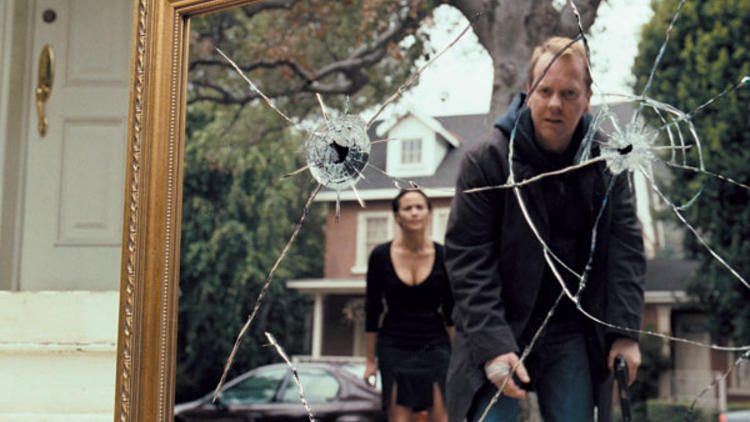
Mirrors, a 2008 horror thriller from director Alexandre Aja, stars Keifer Sutherland as Ben Carson, a former New York City detective who is recovering from his struggles with alcoholism after his involvement in a recent shooting. To help himself stay focused on recovery, Ben takes a job as a night watchman at an abandoned department store called The Mayflower which had partially burned down decades prior. Ben discovers that the previous night watchmen inexplicably went to great lengths to care for the many large mirrors that inhabit the building. Soon after, Ben discovers that they aren’t any ordinary mirrors. These mirrors have someone or something inside of them and they aren’t looking for a polite conversation, they are looking for vengeance and blood. Ben must navigate the murky waters of his own sanity in order to save his family and his soul.
Mirrors is an American remake of a Korean film from director Sung-ho Kim who is credited as co-writer on this remake. Although I have not yet seen the original film, it is praised for its originality and concept but also criticized for being extremely slow and plodding.
Rounding out the cast alongside Keifer Sutherland are Paula Patton as Ben’s estranged wife, Amy Smart as Ben’s caring sister, and the late Cameron Boyce in an early performance as Ben’s son. The supporting cast is mostly serviceable here, Amy Smart probably standing out the most. I really felt her character’s love and care for her brother. On paper, Keifer should fit well in his role considering his history of playing intense detective characters such as Jack Bauer on 24. What works in 24, doesn’t really work here. And unfortunately, he plays the exact Jack Bauer character with just a few more existential struggles. In some scenes he’ll go from completely calm to abusive screaming in about 0.5 seconds. Instead of drawing me straight into the character’s intensity, I found myself laughing at his over-the-top mood swings, just asking myself, “Why are you yelling, Keifer?” Granted, this emotionally unhinged nature should fit the character well on paper, but Keifer’s execution is just too disjointed and unbelievable.
The dialogue also feels stone cold at times, giving the audience the desire to ask that fateful question: “Do people really talk like this?” Audiences only seem to ask that question when the answer is undeniably “Not in the slightest.” For example, although Amy Smart’s loving performance is achieved physically, she gets little help from the script, causing it to feel like a would-be great performance that is hindered by no fault of her own. That being said, great actors can turn crap dialogue into gold, but they can still only do so much when the script is this wooden. Speaking of Amy Smart, her character is involved in one of the best kills in the movie, maybe also being up there as one of the best horror movie kills of all time. I don’t want to spoil too much, but this kill has just about everything: tension, character stakes, gore, and just a general disturbing quality. The movie is actually quite light on kills for horror movies from this era and a part of me wanted a bit more carnage candy, but the kills that we do get are spaced out well and mostly effective. The kills all support the story in some sense, so it tastefully avoids filling the runtime with death that doesn’t really mean too much in the grand scheme of things.
What this movie suffers from the most is feeling like a lot of mystery/horror/thriller hybrids that we got a lot of in this era. The problem with having a mystery ghost story is that the only real question is: What does the ghost want? No whodunnit mystery, no is it or isn’t it real mystery, and no big twist to make the viewer backtrack and put the pieces together. Although I am interested in what the ghost wants, it struggles to keep the viewer’s attention when it is the main driving force of the story. It drags us to a conclusion/explanation that more or less comes out of nowhere and doesn’t much relate back to the puzzle pieces of the original mystery. It makes a viewer wonder what the point was of the previous 90 minutes and that’s not a feeling you want your audience to have. Not to mention we end in a climax with no real surprises of any kind.
Overall, the movie succeeds at being a well-shot horror thriller that archives its goals as long as the viewer isn’t expecting too much in terms of originality or performance. It has a unique horror premise and takes advantage of it just enough to satisfy the audience who sees this movie on the promise of that premise alone. Where the movie fails is its originality, dialogue, and its ability to sustain interest/tension in the mysteries that it presents. If you like the genre and don’t want to risk diving into the muddled waters of older B horror movies, the quality that this movie inherently achieves because of the era in which it was released might make for a safer choice. WHY ARE YOU YELLING, KEIFER? C

 The Movie Matt